Poster Presentation 25 September 2026
Responsible AI Access to Research Repositories: An MCP Server for African Studies Data
Abstract
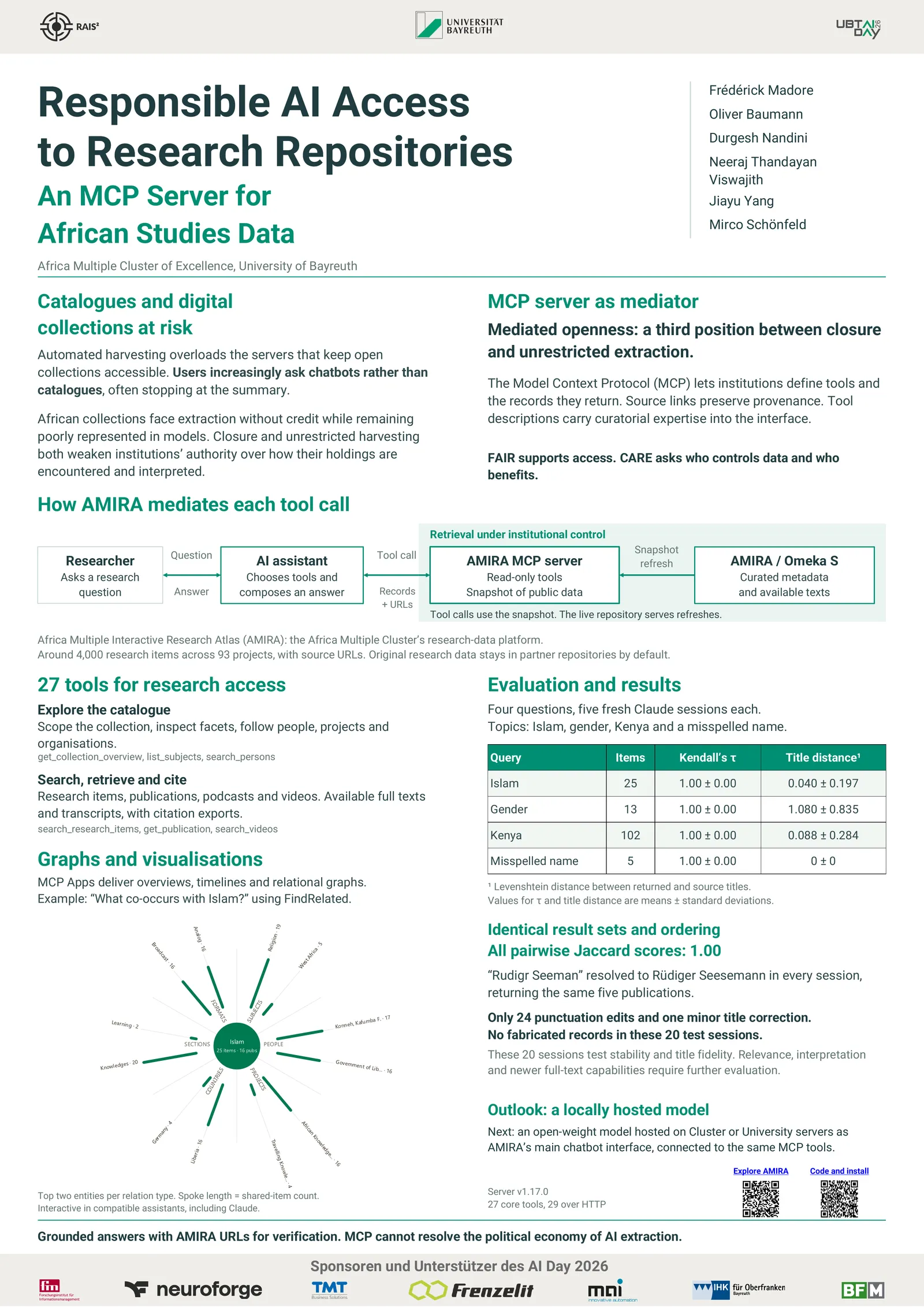
As large language models (LLMs) increasingly mediate access to digital repositories, institutions face a choice between blocking AI access entirely and surrendering their data to unrestricted extraction. We argue for a third position, mediated openness, and demonstrate it through an open-source Model Context Protocol (MCP) server built for the Africa Multiple Interactive Research Atlas (AMIRA), the multilingual research-data platform for African studies developed within the “Africa Multiple” Cluster of Excellence. The server lets conversational AI assistants query AMIRA’s metadata on the institution’s own terms: read-only, provenance-preserving, and governed by the underlying data reconciliation infrastructure rather than by model inference. Twenty-six tools cover structured search, record retrieval, full-text and transcript search, and relational discovery; the signature tool, FindRelated, operationalises co-occurrence across people, places, subjects, projects and formats, turning a static metadata graph into something an LLM can reason over responsibly. We evaluate the system along the two axes most relevant to trustworthy AI-mediated research access: response stability and source fidelity across repeated sessions. Identical queries posed in independent sessions returned identical, correctly ordered result sets, and even a misspelled query was resolved correctly rather than producing a fabricated answer. MCP does not resolve the political economy of AI data extraction, but it offers institutions a concrete, sovereignty-preserving architecture that keeps governance, provenance and epistemic authority with the data holder rather than the model.
Poster
 (PDF, opens in new tab)